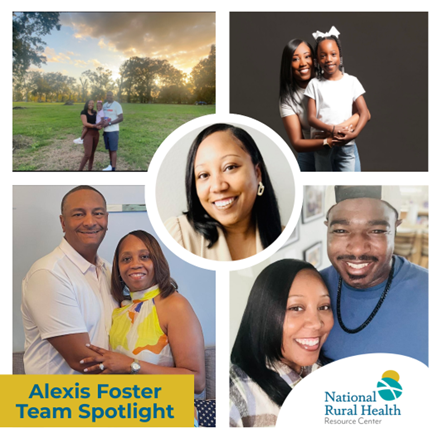
Alexis Foster did not grow up in a rural community, but she is not far removed from it. “My family’s roots are in a rural community, but I grew up one step removed from that experience.”
Alexis’s parents grew up not far from where she now lives, and their influence continues to shape her perspective and appreciation of life in rural America. “It’s what you could imagine,” she says of their upbringing. “Friday night lights, weekly trips to Walmart, everyone knows everyone .”
That connection carries into her work. As a lead program specialist, Alexis plays a key role in the workforce and leadership development technical assistance The Center offers. Her work puts her close to the workforce challenges rural communities face, and she witnesses firsthand the factors that contribute to employee recruitment and retention. “I see a disconnect between the need to hire new staff and the need to keep the staff they have,” she shares, noting that finding that balance is difficult for many rural health care organizations due to competing needs.
She speaks passionately about “peace of mind” in an organization, something often revealed through the employee engagement assessments she conducts. “What’s the value?” she asks. “The value of peace, consistency, and security? It’s important to focus on culture even as organizations look to onboard new staff. How do you get them to stay after you get them to show up?”
It is a question being asked nationwide. Many states have identified workforce as a core focus area for Rural Health Transformation Program funding this year, and conversations often center on sustainability. “It’s a whole organization approach,” Alexis notes. “Leadership training is important, and incentives are important, but culture doesn’t stop at the C-suite. Organizations need to recognize the value across the full employee experience.”
She has seen positive results in her work. Organizations that show the greatest improvement in year-over-year employee engagement assessments are those that address both cultural and technical concerns. “It’s not always a heavy lift, but leaders don’t always know where to look. That’s where we come in.” Her day-to-day work often involves speaking with health care employees about what they value, and presenting those insights in a meaningful way so leadership can incorporate them into action and implementation planning.
“I like being a representative of the workforce,” Alexis says when asked what she finds most rewarding. “I get to be in a place and listen to voices that leaders don’t often hear. Representing them objectively is important.”
She understands the broader impact workforce stability has on rural communities. When employees leave, services are lost. When services are lost, people seek care elsewhere, and resources leave with them. A strong workforce supports the community where employees live and work.
That understanding is personal. Her family’s roots are in a rural community, but she grew up one step removed from a lack of access because of her parents’ hard work. Their determination created opportunity that was not always there before. That perspective shapes her efforts in workforce development, focused on helping others reach the same kind of opportunity that can shift outcomes across generations.
These are communities like the ones her parents came from and the ones she still visits with her family. The people she speaks with through her work are the same people providing care, raising families, and showing up at Friday night football games. That work centers on listening to what matters, understanding what people value in their jobs, and ensuring those voices are reflected in the decisions that shape their organizations. “Access to opportunity is just as important as access to care. It can change the course of a family’s future.”
"Rural health care extends into every aspect of life."
For Tabitha Stone, rural health is deeply connected to the communities, people, and values that have shaped her life. In this employee spotlight, learn how her journey back to her rural roots continues to influence the work she does to support rural hospitals and the communities they serve.
Learn about project site visit to Pioneers Medical Center, a hospital that participated in RHPTP to improve quality infrastructure for patients, staff and the community.