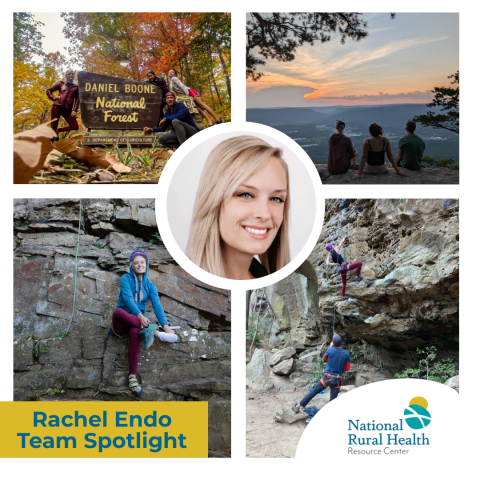
Rolling hills, winding rivers, and a close-knit community. For Rachel Endo, rural is more than just her profession. It’s personal.
Raised in rural Tennessee, Rachel understands the beauty of living rural as well as the unique challenges they face. From spending weekends playing in the creek and visiting her great-aunt’s farm to pursuing a career in public health, rural living has been woven into the fabric of her life from the very beginning. Now as a Program Manager with The National Rural Health Resource Center’s Technical Assistance Services Center (TASC), she continues to serve the rural communities that made her into the advocate she is today.
“Every role that I’ve worked in for public health has connected to rural. It has really helped me to understand the unique challenges that come with accessing care in rural communities and how important it is to shine a light on it.”
Throughout her career in public health, Rachel quickly realized that for rural communities, access is everything. “Highlighting this issue is so important. Many people, especially people in metro areas, don’t recognize the disconnect. Going to a doctor’s appointment might be a low time commitment for them. For someone in a rural community, going to an appointment could mean a 2-hour drive or more. They might even have to take the day off work just to receive routine care.”
Today, accessibility has taken on a whole new meaning. Her day-to-day as part of TASC is dedicated to supporting State Offices of Rural Health where she helps Flex and SHIP Coordinators implement impactful programs that will benefit their hospitals and states. Whether she is fielding requests for support, providing in-depth TA, or preparing for events, relationship building and strengthening community partnerships are key in addressing the biggest issues impacting rural providers.
“We get to build relationships with people who are on the ground and seeing the impact,” says Endo. “Even though our work can be more behind-the-scenes, it’s powerful and heartwarming to hear their stories. It’s proof that we’re making a difference.”
Through partnerships with state Flex Programs, critical access hospitals, and emergency medical services, Rachel pinpoints financial viability as routinely being one of the biggest challenges providers are facing in rural communities. With funding cuts and legislation reshaping the rural health landscape, providers are also consistently met with low patient volumes combined with high fixed costs and reimbursement inequity. These financial pressures directly impact access to care, as service lines are oftentimes limited or eliminated to save money.
Rural health can take on different meanings for different people. For Rachel, its importance is defined by its impact. “Rural health is important because it helps ensure better health outcomes across the board. It helps ensure there is more preventative care – that people aren’t waiting until the last minute to get care. It ensures that people can stay in their communities, build strong relationships, and have more community buy in.”
From her generational ties to the heart of Tennessee to working alongside public health experts throughout the country, Rachel’s belief in rural health continues to be rooted in community. Today, she continues to turn that lifelong principle into impactful initiatives that strengthen systems of care and improves health outcomes for all.
"Rural health care extends into every aspect of life."
For Tabitha Stone, rural health is deeply connected to the communities, people, and values that have shaped her life. In this employee spotlight, learn how her journey back to her rural roots continues to influence the work she does to support rural hospitals and the communities they serve.
Learn about project site visit to Pioneers Medical Center, a hospital that participated in RHPTP to improve quality infrastructure for patients, staff and the community.
“We can’t always fix a rural problem with a big city solution."
In this month's employee spotlight, The Center's Lead Program Specialist, Mike Rowland, shares his thoughts on growing up in a rural community, how his background influenced his perspective, and his role in leading technology conversations with rural hospitals and clinics.
“Access to opportunity can change the course of a family’s future.”
As a lead program specialist, Alexis is no stranger to workforce and leadership development and understanding the ways in which its broader impact has on rural communities. In this month’s employee spotlight, Alexis shares her thoughts on what it means to be a representative of the workforce, how to maintain sustainability in an organization, and the importance of listening to what matters.
“Our mission and our vision speak to me because the work that we do is important."
Throughout her 30-year long career with The Center, Lead Program Specialist Angie LaFlamme's passion for supporting rural organizations has remained constant. In this month's employee spotlight, hear Angie's reflections on her path in The Center, the importance of value-based care, and what it means to keep community at the heart of her work.